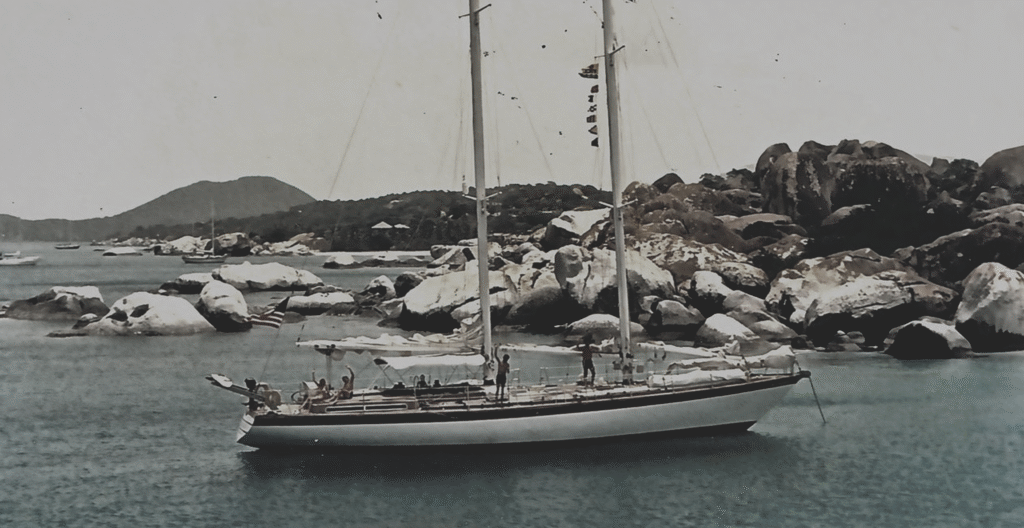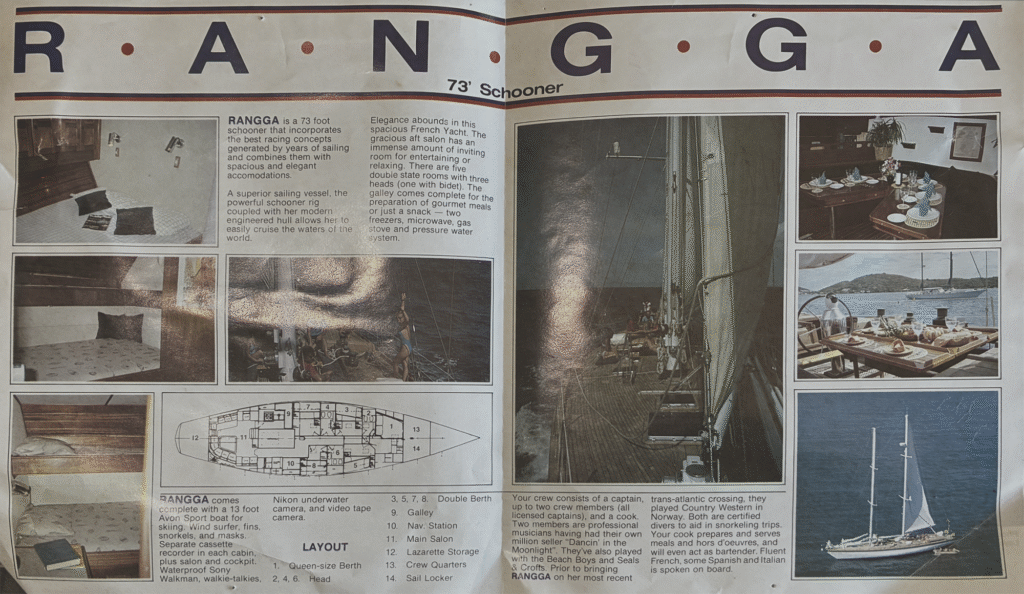
The shine was off of Fort Lauderdale by this time. I was undergoing some therapy in connection with a church I was involved with when the offer came from friends to go to the South of France and recommission a 73’ steel schooner. I considered not going so as to complete my therapy but another good friend said, “Are you crazy? Go to France”, so Rod and I made our way to Antibes, or more accurately to Biot in the hills above Antibes, where the Chantier Naval de Biot was located. We joined the boat in the shipyard where it was built and spent a few months fixing bits that had broken when the Rangga went up on the rocks on Reunion . We learned a lot about what boat parts were called in French, eventually recommissioning most of the systems on that magnificent vessel, water tanks, electrics, pumps, rigging, nav gear and then it was time to put in in the water to see if it was going to float (“faire la planche’). We rode on the deck on a special truck for transporting large yachts, pushing the power lines out of our way with a couple of poles all the way down the hill from Biot to Antibes for the “Mise a l’eau”. Two more months in port gathering a crew and shaking things down. As the guy from the boatyard said, “On casse tout et tout refait apres or “We break everything and fix it all later” – an accurate assessment of our activities.
There were some dodgy characters on that waterfront. People were coming out of the woodwork to see the Rangga revived. One diver stole our anchor and sold it back to us in the market a few days later. Rod had his laundry stolen by another dock rat. Those boys down there would steal anything that wasn’t tied down. We left Antibes to great fanfare and some relief and sailed off to Marseilles to pick up Josie who was eloping with our French cook Thierry and spirit her out of France. Pretty romantic. I remember sailing out of Marseilles to Jimmy Buffet’s song “A Pirate Looks at 40”.
We hit a few islands in the Med, cooped up for a few days in Almeria, Spain running before a monster gale. We tied up and crashed and in the morning we were surrounded by the Basque fishing fleet, beautiful boats all in different colors depending on their origin and so clean you could eat off the engine room floor. We were invited aboard and shown how they tie their jigs on to catch tuna. That was my first encounter with the Basques (no, not Spanish) – the most beautiful friendly people ever. We eventually made it to Gibraltar, the British enclave in southern Europe and a truly filthy port, at least the part we were in. I had a beer in the pub where Nelson drank and after a week or so we made it out through the Straits of Gibraltar which the Romans called the Pillars of Hercules and into those huge Atlantic rollers. On to the Canaries and since the tradewinds (the ‘alisees’) were not yet established at that latitude we headed south along the coast of Africa.
Our jumping off point for the trans-Atlantic run was the archipelago of Capo Verde. When we got to our first uninhabited island in that archipelago we rowed the inflatable to shore looking to spear some fish. We got caught by the wind and current and just managed to hit the tip of the island. If we had missed it was a couple of hundred miles to Senegal. When we got to the next island and anchored we were beset by the natives who came out in small boats and with no embarrassment at all boarded us in droves. We were the first vessel in that little harbor in a year and a half and they were so glad to see us that we were showered with lobsters which they ‘traded’ for apples and cigarettes which we had. I had the impression that you could have bought half the island for a carton of Camels. The port captain who was also the mayor, dressed in Cuban style fatigues and sporting the only gun on the island declared a public holiday. We proceeded to lead the parade up the hill (on the only road in town) singing some songs and met the main local elder and his wife. We shared some Cana with them and he showed us his Social Security check from when he had been a whaler on an American whaling ship.
Cap Verde had been a Portuguese protectorate. I had never seen such beautiful children – their complexion was a mixture of African black and Mediterranean olive and impossibly guileless dark wonderful eyes. In the main port there were sacs of American and Russian “aid” packages marked clearly “Not For Sale”, equally clearly being sold without apology. We hung around the archipelago for a week or so and one night at anchor Rod, Patrick and I were on deck and said to each other ,”Time to get the hell out of here” so we cranked up the engine, pulled the hook, surprising Enrico our captain who was asleep and headed West toward the Antilles. A pod of Orcas followed us for nearly a week, a bull, nearly half as long as our 73’ sailboat, a cow and a calf, pointing out the way to the Caribbean. Also a bunch of sharks waiting for someone to fall off the boat. Becalmed for three days but the wind finally started up again and we landed in Antigua on the day after Christmas 1984. A day or two out we started to pick up sea birds so we knew we were close to making landfall. The color green after all that deep blue was like a holy grail and Thierry, when he smelled the barbecue from shore fell into kind of ecstatic French state of culinary delight ( “Ah le scent de girllades ! ” , said he.) From there it was on to St. Thomas in the US Virgin Islands where we plied the charter trade for the next couple of years. It’s a duty free port. Good Cruzan Rum was a dollar a bottle.
Coca Cola was much more expensive, so when you ordered a Rum and Coke it looked like a weak glass of iced tea. The liquor store where we provisioned for the charters used to clean the counters with vodka. A week long charter usually chewed up $1000 worth of food and $1000 worth of booze. Every season we’d sail down to St. Barts and stock up on fine French wine, the very best kind of ballast. Anchored in Gustavia Harbor we could take the dinghy in to Jimmy Buffet’s “Cheeseburger in Paradise” nightclub to get righteously spiflicated on Elephant Beer. The best of times.
Rod stayed on with Rangga years after I left and the grand old schooner eventually came ashore in a hurricane wiping out a concrete dive shop. I heard she was eventually sold and the new owner put a huge doghouse on her deck – a crying shame and an insult to her lovely lines. But I guess we had the best of the old girl, that magnificent vessel The Good Ship Rangga.